
Thank you for your request!
We have received your message and will try to respond as soon as possible


How do search engines know where a phone number is located on a page? How do they distinguish a company logo from a decorative graphic? How do they understand the relationship between price, availability, and reviews on a product page?
To streamline data collection and make page content unmistakably clear for Google and Bing bots, developers created semantic markup (also known as Schema markup) - a structured method of describing content directly within the page's code.
Schema markup helps search engines accurately interpret your site’s content, generate Rich Snippets, and enhance the visual appeal of your pages in Search Engine Results Pages (SERPs).
Schema markup (Structured Data) is a specialized format of metadata added to a page's HTML. It defines the meaning of specific content elements such as products, contact information, reviews, navigation, and events.
When a search bot crawls structured data, it doesn't just "see" text or images; it understands:
Exactly what it’s looking at (a product, an article, a local business, or an FAQ).
How attributes are linked (which price belongs to which product).
Which data is critical for display in search results.
Pro Tip: While Schema markup is not a direct ranking factor (meaning it won't automatically jump you to position #1), it directly impacts:
Snippet Appearance: Making your result stand out.
CTR (Click-Through Rate): More visual info leads to more clicks.
Data Accuracy: How search engines and AI models (like Gemini or ChatGPT) interpret your brand.
Essentially, Schema is the official, recommended way to "explain" your website to search engines.
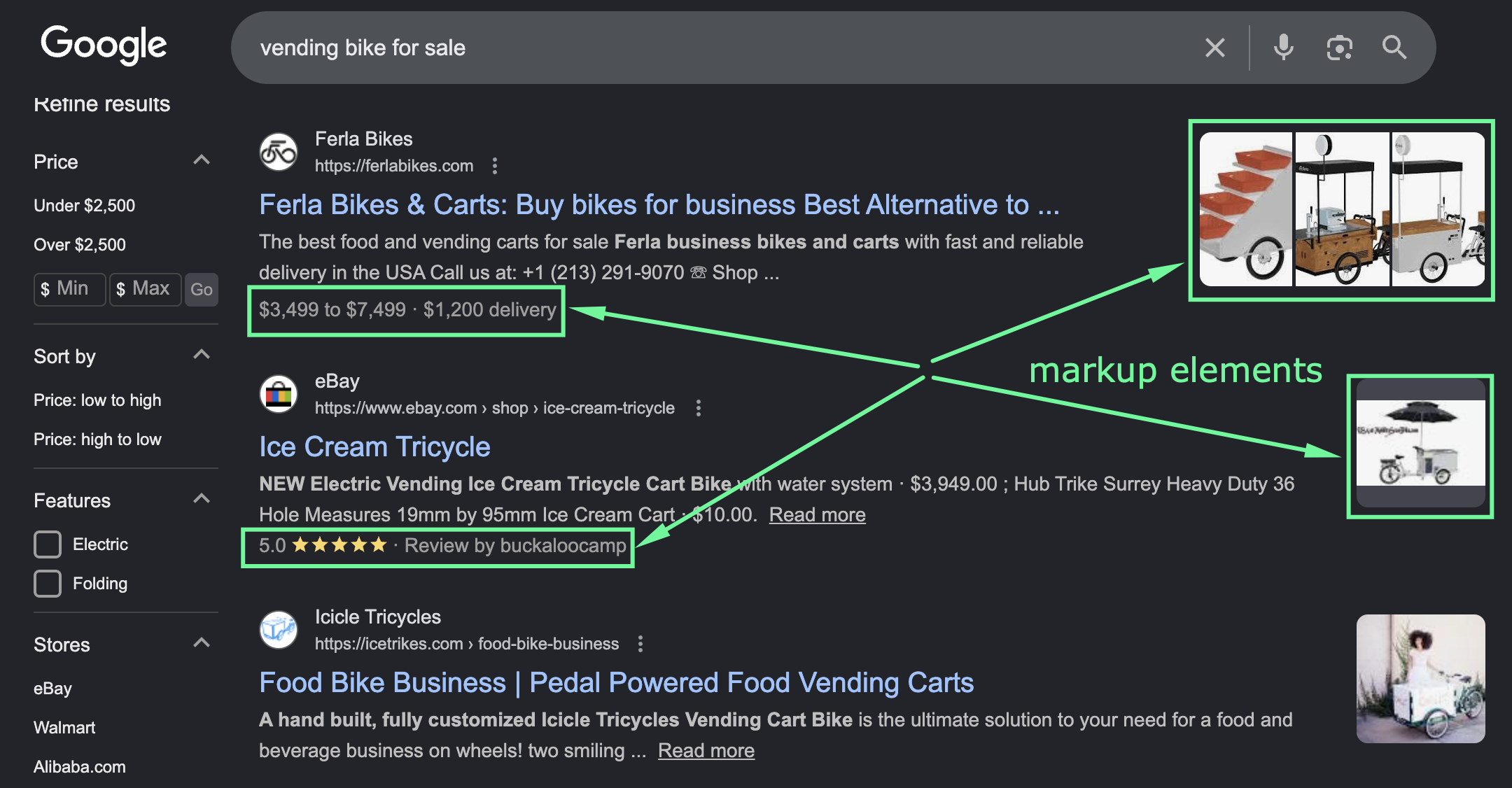
Semantic markup consists of two primary components:
The Vocabulary: Defines which types of objects and properties can be used.
The Syntax: Defines the technical format used to write this data into the code.
Schema.org: The industry standard. Supported by Google, Bing, and Yahoo. This is used for nearly all SEO tasks, including products, organizations, and reviews.
Open Graph: Created by Meta (Facebook). It controls how your links look when shared on social media (title, thumbnail, description). Vital for social traffic, but separate from technical SEO.
Microformats: Simplified HTML patterns. Rarely used in modern SEO compared to Schema.org.
JSON-LD (Recommended): A JavaScript-based format. It lives inside a <script> tag and doesn't interfere with the visible HTML. This is the gold standard recommended by Google.
Microdata: Nested directly within HTML tags. It's harder to maintain and makes the code "messy."
RDFa: An extension to HTML5. Often used in complex data projects but less common in standard SEO.
While you can mark up almost anything, you should focus on data that provides a clear benefit. Over-tagging can lead to validation errors or maintenance headaches.
Identifies your company, logo, and social profiles.
<script type="application/ld+json">
{
  "@context": "https://schema.org",
  "@type": "Organization",
  "name": "G-WEB.GROUP",
  "url": "https://g-web.group",
  "logo": "https://g-web.group/logo.png",
  "contactPoint": {
    "@type": "ContactPoint",
    "telephone": "+1-800-555-0199",
    "contactType": "customer support",
    "availableLanguage": ["en", "es"]
  },
  "sameAs": [
    "https://www.linkedin.com/company/g-web-group",
    "https://www.facebook.com/gwebgroup"
  ]
}
</script>
Crucial for E-commerce. Displays price, currency, and stock status in search results.
<script type="application/ld+json">
{
  "@context": "https://schema.org",
  "@type": "Product",
  "name": "Acuvue Oasys Contact Lenses",
  "image": ["https://example.com/images/acuvue.jpg"],
  "description": "Two-week disposable contact lenses for sensitive eyes.",
  "brand": {
    "@type": "Brand",
    "name": "Acuvue"
  },
  "offers": {
    "@type": "Offer",
    "url": "https://example.com/product/acuvue-oasys",
    "priceCurrency": "USD",
    "price": "45.00",
    "availability": "https://schema.org/InStock"
  }
}
</script>
Adds those "star ratings" to your snippet, which significantly boosts CTR.
"aggregateRating": {
  "@type": "AggregateRating",
  "ratingValue": "4.9",
  "reviewCount": "254"
}
Allows your questions and answers to appear directly in the SERP.
<script type="application/ld+json">
{
  "@context": "https://schema.org",
  "@type": "FAQPage",
  "mainEntity": [{
    "@type": "Question",
    "name": "How often should I replace my lenses?",
    "acceptedAnswer": {
      "@type": "Answer",
      "text": "It depends on the type: daily disposables are replaced every day, while others may last two weeks."
    }
  }]
}
</script>Used for product listings, category pages, or "Top 10" style articles. It helps search engines understand the sequence and relationship of items in a list.
<script type="application/ld+json">
{
  "@context": "https://schema.org",
  "@type": "ItemList",
  "name": "Daily Disposable Contact Lenses",
  "itemListOrder": "https://schema.org/ItemListOrderAscending",
  "numberOfItems": 3,
  "itemListElement": [{
    "@type": "ListItem",
    "position": 1,
    "url": "https://example.com/product/lenses-1"
  },{
    "@type": "ListItem",
    "position": 2,
    "url": "https://example.com/product/lenses-2"
  },{
    "@type": "ListItem",
    "position": 3,
    "url": "https://example.com/product/lenses-3"
  }]
}
</script>
The standard for blog posts and news articles. It provides search engines with metadata like the headline, author information, and publication dates, which helps your content appear in Google News and "Top Stories" carousels.
<script type="application/ld+json">
{
  "@context": "https://schema.org",
  "@type": "BlogPosting",
  "headline": "Understanding Website Schema Markup",
  "description": "A comprehensive guide to structured data and JSON-LD implementation.",
  "author": {
    "@type": "Person",
    "name": "Volodymyr"
  },
  "datePublished": "2026-02-01",
  "dateModified": "2026-02-03",
  "mainEntityOfPage": {
    "@type": "WebPage",
    "@id": "https://example.com/blog/microdata"
  }
}
</script>
Creating schema markup can be done in several ways, and the choice depends on:
The type of website;
The CMS or framework being used;
Search engine requirements;
The technical expertise of your team.
Manual Coding
The most flexible and accurate method. It provides full control over the data structure and allows you to tailor the markup to specific business use cases.
Online Generators
Third-party services that generate JSON-LD based on the data you input. These are suitable for simple scenarios but often produce "cookie-cutter" or template-based solutions.
Note: Official markup helpers often have limited functionality and may not correctly represent complex structures, making them suitable only for basic tasks.
The best and most recommended method is direct integration into the website’s code by a developer. This minimizes the risk of errors and ensures the page isn't overloaded with external scripts.
Alternative Options:
Implementation via Google Tag Manager (GTM);
Using SEO plugins or dedicated CMS modules.
However, these alternative methods have limitations and require additional verification to ensure they are firing correctly.
To ensure your code is valid, use these official tools:
Google Search Console Structured Data Report;
Rich Results Test to evaluate eligibility for enhanced search results;
Schema.org Validator for general syntax checking;
Open Graph Debuggers for social media optimization.
It is best practice to perform a validation check after every significant page update.
Schema markup is a powerful tool for managing how your site is represented in search results. When used correctly and strategically, it allows you to:
Improve CTR (Click-Through Rate);
Make your snippets more informative;
Build user trust before they even click;
Ensure accurate content interpretation by search engines and AI models.
Properly implemented schema markup does not replace traditional SEO—it acts as a force multiplier for its effectiveness.